CNC Bending

CNC Bending

Our state-of-the-art bending equipment is amongst the best in the world. These days the bending process is so advanced that it has virtually eliminated distortion.

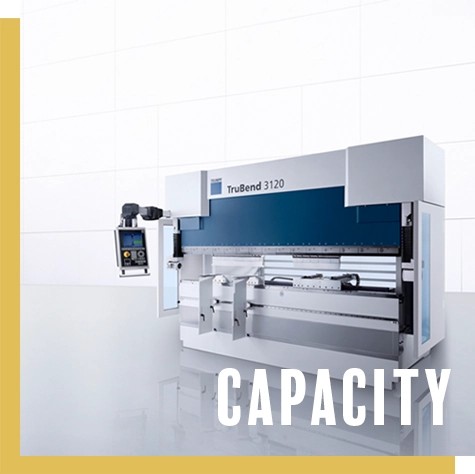
St Ann’s Sheet Metal Company can service all your bending requirements with our on-site press brakes. We offer high volume services including forming, bending and rolling, from the following brake presses:

  • AMADA ITS 50 Tonne 2 MTR
  • PROMECAM 80 TONNE 2.5 MTR x2
  • PROMECAM 50 TONNE 2 MTR x2
  • PROMECAM 25 TONNE 4 FT

We hold a vast library of tools suited for a wide range of bends, rolls and folds, all designed to offer exceptional accuracy and repeatability. Tools allow for a wide range of bend types from standard 90 bends, deep bending for enclosures, L-shapes and hemming through to radius bending and radius rolling.

Press Brakes

A press brake is the machine that is used to bend. The lower section contains a V-shaped groove (or ‘die’) while the upper section contains the punch that presses the sheet metal down into the die, causing it to bend. These days the most common method is air bending.

Air bending

In air bending the die has a sharper angle than the required bend and the upper tool is precision controlled to push the material down allowing it to bend. A general purpose air bending machine has a bending force of around 25 tonnes per metre of length.

The opening width of the lower die is typically 8 to 10 times the thickness of the metal to be bent while the inner radius is determined by the lower die width. Typically, the inner radius is equal to 1/6th of the V-width used in the forming process.

Precision

A back gauge is usually used to position the depth of the bend along the workpiece. This is computer controlled to allow the operator to make a series of bends to a high degree of accuracy.

Simple machines control only the backstop, however more advanced machines control the position and angle of the stop, its height and the position of the two reference pegs used to locate the material. The machine also records the exact position and pressure required for each bending operation allowing the operator to achieve a perfect 90 degree bend across a variety of operations.

Roll forming

Roll forming is a continuous bending operation where longer metal pieces are fed through consecutive rollers. Each set of rollers perform an incremental part of the overall bend until the desired cross-section profile is obtained.
Roll forming is ideal for producing components with long lengths, for producing open profiles or welded tubes. Roll forming is also useful for producing longer lengths or large batches.

Production lines

Roll-forming lines can be set up with multiple configurations, punching and removing parts in a continuous operation. Components are cut to length using pre-cut dies where a single blank runs through the roll mill. Alternatively post-cut dies are used where the profile is removed after the roll forming process.

Features such as holes, notches, embossing or shearing may be added using punching in a roll-forming line. These can be done pre-punch, mid-line or post-punch.

Some roll-forming lines incorporate just one of the above punch or cutoff applications whereas others incorporate most or all of the applications in one line.

Profile variation

In roll forming a variety of cross-section profiles can be produced, with each profile requiring a carefully crafted set of roll-tools.

Design of the rollers starts with a flower pattern, which is the sequence of profile cross-sections, one for each stand of rolls. The roll contours are then derived from the profile contours.

Because of the high cost of roll sets, simulation is often used for validating the designed rolls and to optimize the forming process. This minimizes the number of stands and the material stress in the final product.

For Laser Cutting, CNC Punching and a full range of other Sheet Metal services
call 0115 9269649, contact us by email or enquire online.

© 2012 Saint Anns Sheet Metal Limited : Click Here to view our BSI Certificate : Sitemap

Web Design Nottingham by Spidered Web